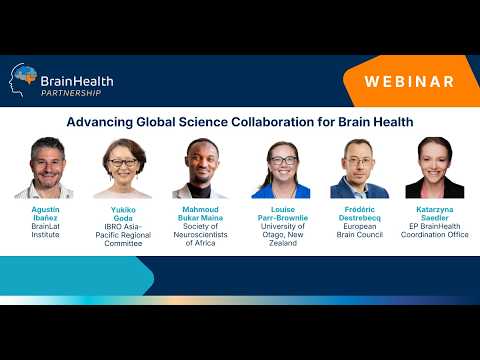

On 18 June 2026, the European Partnership for Brain Health (EP BrainHealth) hosted its first global webinar, “Advancing Global Science Collaboration for Brain Health”, bringing together leading experts and stakeholders from Europe, Latin America, Africa, Asia-Pacific and Oceania to explore how international cooperation can accelerate progress in brain health research, innovation and policy.

Organised within the framework of the Partnership’s global outreach activities, the webinar provided a platform for exchange on the opportunities and challenges facing international brain health collaboration at a time when neurological and mental health conditions are increasingly recognised as major societal, economic and development challenges worldwide.
Introducing the European Partnership for Brain Health
Opening the webinar, Frédéric Destrebecq, Executive Director of the European Brain Council (EBC), welcomed participants and positioned the discussion within the broader ambitions of the European Partnership for Brain Health.
He emphasised that brain health has emerged as a truly global priority, requiring coordinated efforts that extend beyond geographical and disciplinary boundaries. The webinar represented an important step in establishing the EP BrainHealth as a platform capable of connecting initiatives, facilitating dialogue and fostering long-term collaboration across regions.
Katarzyna Saedler, Senior Scientific Officer at the EP BrainHealth Coordination Office (DLR), then provided an overview of the Partnership itself. Bringing together more than 60 institutions from over 30 countries, the EP BrainHealth represents one of the world’s largest collaborative efforts dedicated to brain research and innovation.
She outlined the Partnership’s vision of improving brain health throughout the life course and highlighted the opportunities it offers for researchers, organisations and stakeholders to engage in collaborative activities, future funding opportunities, stakeholder consultations and community-building initiatives. Particular attention was given to upcoming activities related to research infrastructures, data sharing, resource harmonisation and stakeholder engagement.
From Dialogue to Delivery: Strengthening Global Collaboration on Brain Health
The webinar’s panel discussion brought together distinguished experts representing different regions and perspectives:
- Agustín Ibáñez, BrainLat Institute
- Louise Parr-Brownlie, University of Otago, New Zealand
- Mahmoud Bukar Maina, Society of Neuroscientists of Africa
- Yukiko Goda, International Brain Research Organization Asia-Pacific Regional Committee
The discussion offered a rich overview of current developments, challenges and opportunities in global brain health collaboration.
A Shared Global Challenge
Speakers agreed that brain health challenges transcend national borders and require solutions that are equally international in scope. While different regions face distinct realities and priorities, common challenges emerged throughout the discussion, including funding constraints, workforce development, research capacity, data sharing and equitable access to innovation.
Several speakers highlighted the growing burden of neurological and mental health conditions in low- and middle-income countries and stressed the importance of ensuring that global collaborations are genuinely inclusive and mutually beneficial.
Building Capacity Across Regions
A recurring theme was the need to strengthen research capacity worldwide, particularly through investment in training, mentorship and support for early-career researchers.
Agustín Ibáñez emphasized the importance of creating opportunities that enable young researchers to participate in international consortia, develop competitive grant applications and build sustainable global networks. Participants discussed how capacity-building activities can serve as a foundation for long-term scientific excellence and stronger international partnerships.
Science Diplomacy as an Enabler
The panel repeatedly returned to the role of science diplomacy as a mechanism for fostering collaboration across regions, disciplines and political contexts.
Mahmoud Bukar Maina highlighted the particular relevance of science diplomacy for Africa, noting that stronger engagement between scientific communities, governments and international organisations could help address existing gaps in research funding, infrastructure and policy support.
The discussion underscored that scientific collaboration can play a critical role in building trust, facilitating knowledge exchange and creating shared solutions to common challenges.
Inclusive Collaboration Across Diverse Regions
Speakers highlighted that effective global collaboration must reflect the diversity of regional contexts, capacities and needs.
Yukiko Goda emphasised the particular complexity of the Asia-Pacific region, noting that equitable support for neuroscience requires not only international opportunities for training and exchange, but also sensitivity to differences in infrastructure, local priorities and stigma surrounding brain conditions.
These considerations also pointed directly to the importance of data sharing and harmonisation, since inclusive collaboration depends on systems and standards that can accommodate diverse regional realities while enabling meaningful scientific exchange.
Data Sharing and Harmonisation
One of the most extensively discussed topics was data sharing and harmonisation.
Panelists highlighted the significant scientific opportunities associated with international data sharing, while also recognising the practical, regulatory and ethical challenges that often limit collaboration. The need for interoperable infrastructures, common standards and harmonised approaches to cohort development emerged as key priorities for the future.
Participants agreed that addressing these barriers will be essential to unlocking the full potential of global brain health research and ensuring that discoveries can be translated more effectively into clinical practice and policy.
Aligning Efforts Across Organisations
Another key message was the importance of greater coordination between existing initiatives and organisations.
Rather than creating new structures, speakers emphasised the need to connect ongoing activities, share expertise and align efforts across institutions already active in the field. International organisations, funding bodies, scientific societies and regional initiatives all have important roles to play, but stronger communication and coordination could significantly increase collective impact.
Global Partnerships Grounded in Local Context
The discussion also underlined that international collaboration must be anchored in approaches that are responsive to local realities.
Louise Parr-Brownlie highlighted that participation in global partnerships can strengthen scientific contribution and coordination, while also requiring careful attention to cultural context, regional specificity and responsible research practices.
This perspective helped set the stage for the webinar’s closing discussion, which focused on the practical steps needed to translate these principles into sustained and effective global collaboration.
Looking Ahead
The webinar concluded with a forward-looking discussion on practical next steps for strengthening global collaboration.
Among the priorities identified were:
- Enhancing coordination between existing international initiatives and funding organisations;
- Supporting capacity-building and mentorship opportunities, particularly for early-career researchers;
- Advancing work on data harmonisation, interoperability and shared infrastructures;
- Expanding science diplomacy efforts to engage policymakers and funders across regions;
- Creating additional opportunities for dialogue and exchange through future webinars, workshops and international meetings.
Speakers also highlighted several forthcoming opportunities for engagement, including the 2027 IBRO World Congress in South Africa, which will provide an important platform for continued collaboration and global dialogue.
Conclusion
The webinar demonstrated both the growing momentum behind brain health globally and the strong appetite for deeper international collaboration.
Despite differences in geography, resources and local priorities, participants shared a common vision: brain health challenges cannot be addressed by any one country, region or organisation alone. Progress will depend on sustained partnerships, coordinated action and a willingness to learn from one another.
As the European Partnership for Brain Health begins its ten-year journey, it aims to contribute to this effort by providing a platform for dialogue, coordination and collaboration across the global brain health ecosystem.
The message emerging from the discussion was clear: strengthening global collaboration is not simply desirable – it is essential if we are to accelerate innovation, reduce fragmentation and improve outcomes for people living with neurological and mental health conditions worldwide.
Watch the recording